
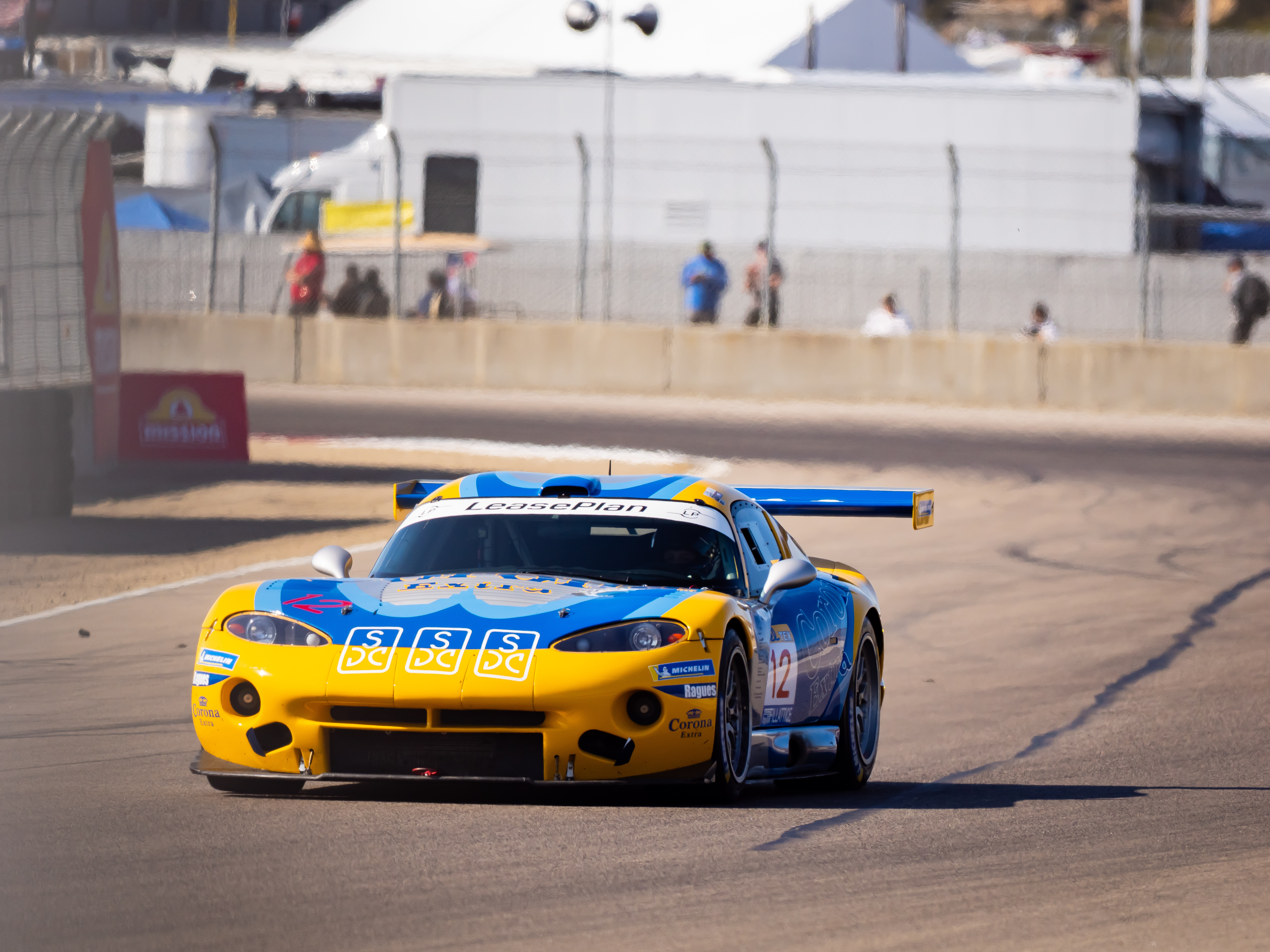
Now owned by 2009 Formula One World Champion Jenson Button, Chrysler Viper GTS-R chassis C25 returned to competition at Laguna Seca with its V10 voice and racing history intact.
Some race cars return quietly, carried by reputation and remembered through photographs, results sheets and the stories of those who saw them compete.
The Chrysler Viper GTS-R has never done anything quietly.
At the 2026 Rolex Monterey Motorsports Reunion, its naturally aspirated V10 rolled across the hills surrounding WeatherTech Raceway Laguna Seca before the car itself came fully into view. Then it appeared: low, wide and unmistakable, wearing the blue-and-yellow colors associated with its years in European competition and carrying the number 12.
This was not simply another historic racing car making an appearance. It was chassis C25, a genuine piece of international GT racing history, now beginning a new chapter under the ownership of Jenson Button.
A Shape That Never Lost Its Presence
Even among the extraordinary machinery assembled at Laguna Seca, the Viper demanded attention.
Its proportions belong to another era. The hood seems to stretch toward the next corner, the cockpit sits far behind the front axle, and the rear wing rises above bodywork shaped with purpose rather than restraint.
It still resembles the road-going Viper, but only just.
The GTS-R was developed through a collaboration between Chrysler, French racing organization ORECA and British engineering specialist Reynard Motorsport. Together, they transformed one of America’s most dramatic production cars into a machine capable of competing against the world’s best GT manufacturers.
Carbon-fiber bodywork surrounded a competition-focused structure with an integrated roll cage. Adjustable suspension, racing brakes and extensive aerodynamic development gave the Viper the control and durability required for international endurance racing.
Yet its identity remained centered beneath that long hood.
The naturally aspirated 8.0-liter V10 produced approximately 600 horsepower and 600 lb-ft of torque in FIA GT specification. Its power reached the rear wheels through a six-speed manual transmission, placing responsibility firmly in the driver’s hands.
There is nothing distant about the experience. Every gear change, every movement under braking and every attempt to manage the engine’s torque becomes part of the conversation between driver and car.

The Story of Chassis C25
The Viper photographed at Laguna Seca is chassis C25, originally acquired by Paul Belmondo Racing for the 2000 FIA GT Championship.
During its first season, the car competed with Paul Belmondo, Vincent Vosse and Boris Derichebourg among its drivers. It quickly established itself as more than a recognizable presence on the grid.
C25 claimed victory at the Hungaroring with Vosse and Derichebourg, followed by second-place finishes at Zolder and the Lausitzring. Those results placed the car firmly within one of the most competitive periods in international GT racing.
The Viper returned in 2001, when its story expanded to include the 24 Hours of Le Mans. It continued racing across Europe in the seasons that followed and remained associated with Paul Belmondo Racing throughout its contemporary career.
That history is still visible in the car today.
The blue-and-yellow bodywork and number 12 connect it to the years when Vipers filled European paddocks with the low, uneven rhythm of their V10 engines. It carries the appearance of a working race car, shaped by competition rather than recreated as a polished interpretation of the past.
At the Reunion, those details mattered. This was not a tribute wearing familiar colors. It was the car that had lived the story.

When the Viper Changed GT Racing
The importance of C25 becomes even clearer when placed within the larger history of the GTS-R.
During the late 1990s and early 2000s, the Viper became one of the defining GT race cars of its generation. It earned championships on both sides of the Atlantic, secured three consecutive class victories at the 24 Hours of Le Mans and achieved overall wins at the Nürburgring, Spa and Daytona.
The results forced the racing world to reconsider what the Viper represented.
Its enormous engine and aggressive shape could have made it little more than a symbol of American excess. Instead, the GTS-R became a disciplined endurance racer, capable of combining power with reliability over the longest and most demanding events in motorsport.
It competed during a period when GT racing was filled with contrasting personalities. Porsche brought precision, Corvette continued developing its own American endurance identity, while Ferrari, Lister and Saleen offered entirely different interpretations of the same regulations.
The Viper never attempted to imitate them.
It succeeded by becoming a more focused version of itself.

A World Champion Behind the Wheel
Jenson Button’s ownership gives C25 another meaningful connection to racing history.
Button is best known for the patience, intelligence and adaptability that carried him to the 2009 Formula One World Championship. His career beyond Formula One has been equally varied, including success in Super GT, appearances at the 24 Hours of Le Mans and an increasing involvement with historic racing.
The Viper feels like an appropriate addition to that story.
It is a car that rewards smooth inputs but never allows its driver to forget the amount of power waiting beneath the hood. Its long proportions, manual transmission and absence of modern electronic assistance require commitment without carelessness.
At Laguna Seca, Button did not bring the Viper simply to be displayed. He raced it.
Seeing a Formula One World Champion guide this front-engined V10 machine through the Corkscrew brought two very different eras of motorsport together. Button’s precision met the Viper’s physicality, while one of racing’s most technically accomplished modern drivers adapted himself to a car built around mechanical communication.
There was speed, but there was also respect.
The Viper moved beneath braking, settled into the corner and then released its torque as the track opened ahead. Each pass carried the unmistakable sound of ten cylinders working without restraint, echoing from one hillside to the next.
For those watching, it became more than a demonstration of historic machinery. It was a reminder of how different racing once felt.

The Story Is Still Being Written
Historic racing matters because it allows the past to move again.
The photographs and results can tell us where C25 competed, who drove it and what it achieved. They cannot fully reproduce the moment its engine starts, the vibration that moves through the ground or the sight of its bodywork loading through a corner.
Laguna Seca gave the Viper that voice again.
For a few laps, chassis C25 was no longer separated from its history by more than two decades. It was once again a working race car, carrying speed into the braking zones and sending its V10 across the Monterey landscape.
Its original chapter belonged to Paul Belmondo Racing. Its newest one now belongs to Jenson Button.
The ownership has changed, but the purpose remains.
The Viper GTS-R was built to race, to be heard and to leave an impression long after it disappeared around the next corner.
At Laguna Seca, it did exactly that.


Continue with our 2026 Monterey Reunion coverage and historic racing photography gallery.
Bring this documentary approach to your driver, team or automotive brand. Explore commissioned trackside photography and editorial coverage →
Article by Chloe Hedley.
Photography by James Hedley, Speed & Spirit Media.