
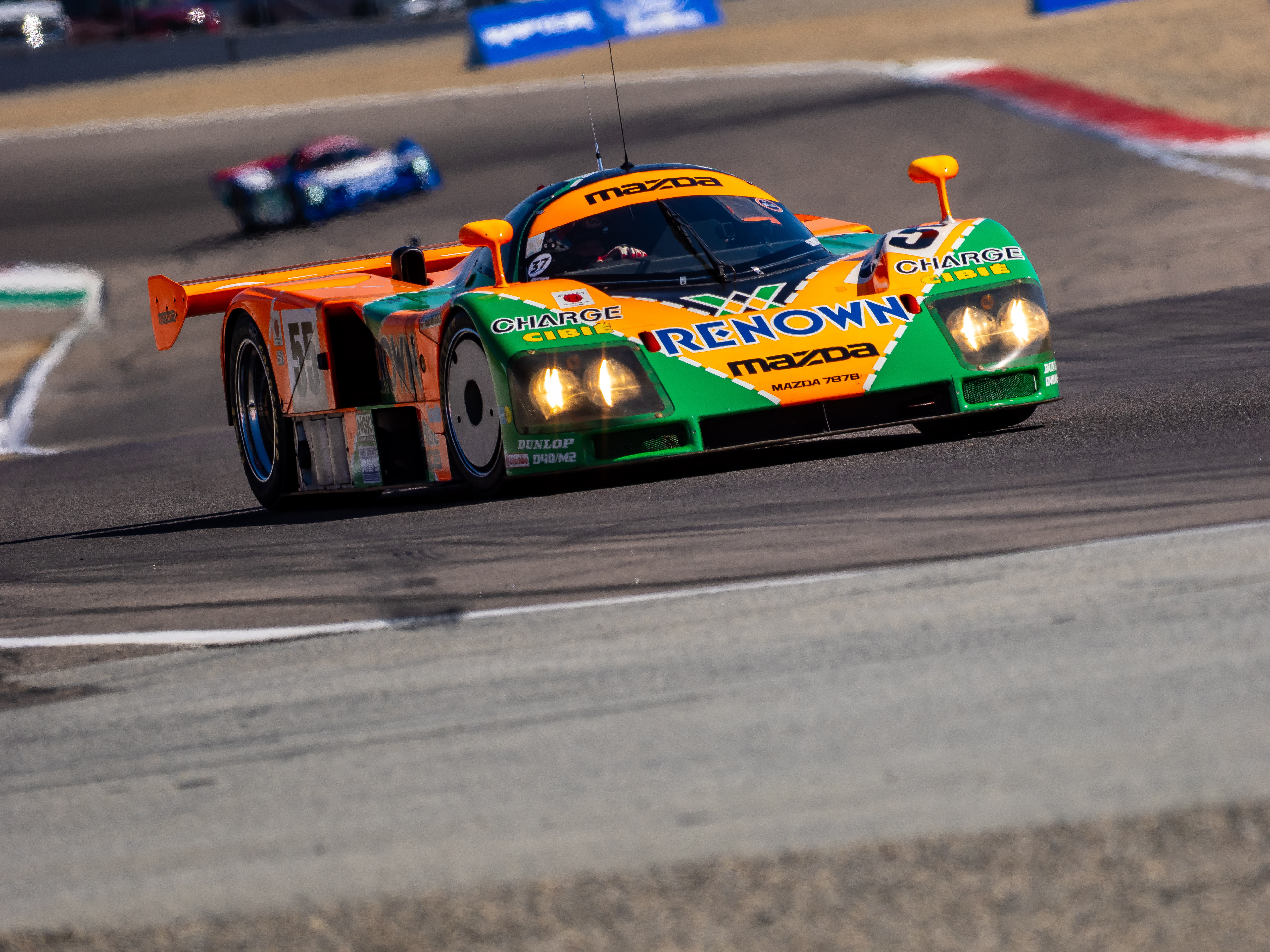
Twenty-seven years separate the Mazda 787B and the Toyota TS050 Hybrid, yet both arrived at the same place in Japanese motorsport history. Each became the car that finally carried its manufacturer to an overall victory at the 24 Hours of Le Mans.
At the 2026 Rolex Monterey Motorsports Reunion, the two cars form one of the most significant pairings within the celebration of Japanese motorsport. They belong to different regulations, different technologies and almost entirely different interpretations of endurance racing. Together, they show that there has never been a single Japanese route to success.
Mazda reached the summit through a four-rotor engine, light weight and an idea unlike anything around it. Toyota arrived through hybrid technology, four-wheel drive and the accumulated knowledge of a long factory campaign.
The objective was identical. The solutions could hardly have been further apart.
Mazda’s Unconventional Victory
The Mazda 787B entered the 1991 24 Hours of Le Mans carrying the culmination of Mazda’s rotary-powered Group C programme.

Its R26B engine used four rotors and produced approximately 700 horsepower. The car weighed around 830 kilograms, giving Mazda a compact and mechanically distinctive prototype during a period dominated by conventional piston engines.
The No. 55 car, driven by Volker Weidler, Johnny Herbert and Bertrand Gachot, completed 362 laps and approximately 4,923 kilometres. In doing so, Mazda became the first Japanese manufacturer to win Le Mans overall and the 787B became the first, and still only, rotary-powered car to achieve that result.
Its victory was significant because it validated an engineering identity Mazda had pursued for years. The rotary engine was not a novelty placed into an otherwise conventional programme. It was central to the company’s approach to performance and a technology Mazda had continued developing despite the difficulty of making it competitive and durable over 24 hours.
The sound is now inseparable from the car’s identity. The 787B does not build toward a familiar piston-engine note. It rises into a sharp, continuous mechanical voice that remains recognizable before the orange and green bodywork comes into view.
Yet the significance of the car extends beyond noise or livery. Its victory demonstrated that endurance racing could still reward an unconventional solution when that solution was supported by discipline, efficiency and reliability.

Toyota’s Long Pursuit
Toyota’s first overall Le Mans victory arrived in 2018 with the TS050 Hybrid.

By then, endurance racing had changed dramatically. The TS050 belonged to the LMP1 Hybrid era, where combustion power, electrical energy recovery, aerodynamic efficiency and software management had become part of one integrated performance system.
The car combined a twin-turbocharged V6 engine with hybrid assistance and four-wheel drive. Its performance came not only from the energy it generated, but from the precision with which that energy could be recovered, stored and deployed throughout a lap.
Sébastien Buemi, Kazuki Nakajima and Fernando Alonso took the No. 8 TS050 Hybrid to victory after 388 laps, with the sister No. 7 finishing second. The result gave Toyota its long-awaited first overall win at Le Mans after decades of effort and several deeply painful defeats.
The victory was therefore about more than a single race. It represented persistence.
Toyota had approached Le Mans through several generations of machinery and regulation. The TS050 carried the lessons of those programmes, including the disappointment of 2016, when victory was lost in the closing minutes.
When the result finally arrived, it did so through one of the most technically sophisticated prototypes of its period.

Two Interpretations of Endurance
The 787B and TS050 Hybrid were both designed to survive 24 hours at racing speed, but the way they achieved that durability reveals how far endurance engineering evolved between 1991 and 2018.
Mazda’s car relied on light weight, mechanical efficiency and the characteristics of its rotary engine. Toyota’s prototype managed combustion power alongside electrical energy, using complex control systems to balance speed, consumption and reliability.
The Mazda was created during the final period in which its rotary-powered approach could compete at Le Mans under the prevailing regulations. The Toyota emerged from an era in which hybrid technology had become central to the highest level of sports-car racing.
One car expressed difference through the engine at its centre. The other expressed it through the coordination of several advanced systems.
Neither victory came easily.
Mazda’s win followed years of rotary development and repeated attempts at Le Mans. Toyota’s arrived after an even longer pursuit marked by near misses, regulation changes and the continuous rebuilding of its endurance programme.
That persistence may be the most important quality the two cars share.
More Than National Milestones
It is tempting to view both cars only through their place in Japanese motorsport history.
The 787B was the first Japanese car to win Le Mans. The TS050 was the first Toyota. Those facts matter, but they do not fully explain why the cars remain important.
Each challenged the idea that there was one correct way to build an endurance prototype.
Mazda’s rotary engine gave the 787B a technical and emotional identity no rival could duplicate. Toyota’s hybrid system demonstrated that efficiency and energy recovery could become sources of outright performance rather than restrictions upon it.
Their victories were not merely national milestones. They were arguments made through engineering and proven over 24 hours.
Together at Laguna Seca
Bringing the Mazda 787B and Toyota TS050 Hybrid together at Laguna Seca creates a comparison that numbers alone cannot communicate.
Their proportions reveal different aerodynamic priorities. Their cockpits belong to different understandings of what information a driver requires. Their engines express performance through entirely different sounds.
Between them sits 27 years of regulation, computation, materials development and accumulated experience.
Yet both carry the same evidence of endurance racing’s central demand: a fast car must first become a car capable of finishing.
Mazda found its answer through the rotary engine. Toyota found its answer through hybrid power.
Two manufacturers took different roads to Le Mans. Both arrived at victory.


Article by Chloe Hedley. Photography by James Hedley and Chloe Hedley, Speed & Spirit Media.
Explore complete 2026 Rolex Monterey Motorsports Reunion coverage →