
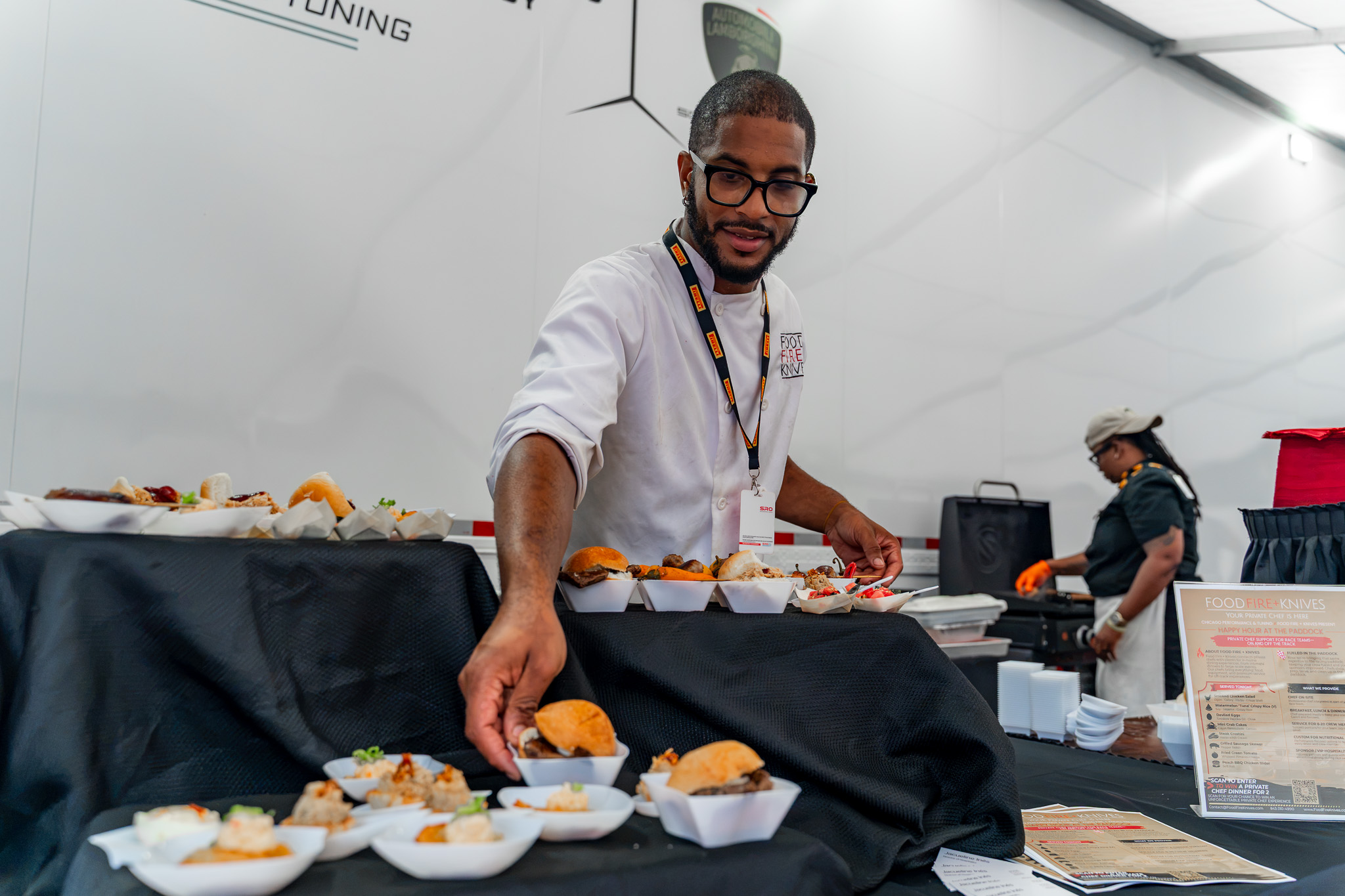
For Chicago Performance & Tuning Co., Food Fire + Knives has become part of the working rhythm of a race weekend, providing race team catering while the team takes care of the car.
Dinner cannot always wait for the garage to fall quiet.
At Indianapolis, Chicago Performance & Tuning Co. had Thursday night practice to work through. The evening meal had to find its place around that commitment, so Food Fire + Knives brought dinner to the pit.
Perch with beurre blanc sauce, sweet potatoes, asparagus or broccolini, and rice were served in bowls that the crew could manage close to the work. Later, when it became clear that four team members still had not eaten, the remaining food was taken back to the garage for them.
The important part of that evening was that dinner remained available after the first people had finished. A racing schedule had interrupted the meal, and someone was paying enough attention to make sure nobody was forgotten.
That is where this partnership finds its meaning.
Chicago Performance & Tuning Co.’s No. 64 Lamborghini Huracán GT3 EVO2 gives the weekend its competitive focus. Keeping the people around it fed is Chef Keenan’s responsibility. Through Food Fire + Knives, he prepares breakfast, lunch, and dinner around the team’s commitments, working within temporary facilities and a timetable that can change with very little warning.
For a group that can approach 20 people, it is a substantial part of the weekend to take off their hands.

The Day Around the Racing
Race weekends tend to be remembered through the sessions on track. For the people working them, the hours before and afterwards matter just as much.
There is preparation for the next morning, work carried over from the last session, and the need to find some rest before it all begins again. Going out for dinner adds another journey to that day. Finding somewhere suitable and getting a large group fed takes coordination at a point when time may already be in short supply.
Chicago Performance & Tuning Co. previously had to make those arrangements or organise outside catering. Bringing Food Fire + Knives into the paddock gives that responsibility to people whose day is built around it.
Keenan’s morning starts before dawn so breakfast can be ready by 7 a.m. By the time the team sits down, he is already several steps into a cycle of preparation, service, shopping, and washing up that will continue into the evening.

The assignment stretches across five to seven days per event. At Sonoma, that meant three meals a day for 12 crew members. Elsewhere, the numbers grow, and the facilities change.
Those practical demands are easy to overlook when food arrives ready to eat. Handling them is what allows the team to turn its attention elsewhere.
One Chef, a Whole Kitchen’s Work
“First and foremost, I love being on a team,” Keenan says. “That’s why I did so well in a Michelin restaurant.”
In the paddock, that instinct for teamwork sits alongside a demanding individual workload. Keenan shops for the ingredients, prepares them, cooks, serves, and washes up. The jobs that a staffed kitchen might divide between several people all belong to his working day.
Each has to leave enough time for the next. Once breakfast has been served, there are dishes to wash and supplies to buy before lunch preparation begins. By around 10:30 or 11 a.m., he is back at the makeshift kitchen, turning his attention to feeding the team again.

Limited refrigerator space makes stocking up for the whole weekend impractical. Keenan shops a couple of times a day, fitting those trips around service while bringing in fresh produce. His schedule has to account for time away from the kitchen as carefully as time spent cooking in it.
After dinner, usually around 7 p.m., the work continues. Equipment goes back to the rental accommodation to be cleaned and made ready for the morning. The team has eaten, but Keenan still has to finish the work that will allow him to serve breakfast the next day.
Across five to seven days, that cycle requires sustained attention. Dietary requirements must carry through from the shopping list to the plate. Quantities have to suit the group. Preparation must stay ahead of service, even when the racing timetable moves.
There is no single task that captures the weight of it. The demand comes from holding all of those responsibilities together, repeatedly, while staying flexible enough to meet the team’s needs.
A meal ready in the paddock gives the crew one less thing to think about. For Keenan, it represents a succession of jobs he has already handled and another set waiting once everyone has finished. That is the daily commitment behind the team’s trust in him.

Feeding Drivers and Crew: Different Needs, One Team
Cooking for the same team across several events brings a familiarity that a menu alone cannot provide.
Keenan describes tailoring menus to keep the drivers energised and well fed on race day, while preparing heartier, family-style meals for the crew. Learning how to feed them has also meant learning about the people themselves.
“This has been the perfect marriage,” he says.
After Chicago Performance & Tuning Co.’s first race in 2026, Food Fire + Knives gathered the team’s dietary preferences to help shape the service. Allergies, restrictions, and driver nutrition plans all had to be accommodated, along with the tastes of the crew.

That knowledge travels with Keenan from circuit to circuit. The working conditions do not.
At Indianapolis, the kitchen was beside the trailer, while the team’s meal tables were in the garage. Getting lunch to the people eating it meant moving food between the two and setting up in a space already occupied by the car and around 20 people.
The crew helped make the arrangement work. Food Fire + Knives could serve the buffet, then clear the space so the team could get on with its day.
A menu drawn up in advance provides direction, but the final decisions depend on what the circuit allows, what local shops can supply, and what the team needs that day. Each event gives the catering operation something to learn for the next one.
Over time, that becomes a working understanding of the people being fed: their requirements, their routines, and the moments when a meal might otherwise pass them by.

Managing Meal Times With the Team App
A race weekend leaves little room for separate schedules. The car may need attention just as lunch is due, or a session may push dinner further into the evening. Keenan has to manage the preparation of a meal while remaining flexible about when the team can eat it.
Food Fire + Knives stays connected through the team app, which helps keep the catering operation in step with the people it is feeding. It provides a shared point of communication as the day develops, allowing meal arrangements to follow the team’s working schedule.
That connection matters because cooking cannot simply stop and restart whenever the timetable changes. There is food to prepare, transport to arrange, and a meal to keep hot and ready. Knowing what is happening around the car helps the catering team adjust those decisions before service becomes another demand on the crew.

At Indianapolis, the distance between the kitchen beside the trailer and the tables in the garage added another consideration. Timing had to account for getting the food to the team, as well as preparing it. During Thursday night practice, the solution was to bring dinner to the pit.
The aim is to make eating fit into the day without asking the team to organise another part of it. Time saved on finding food or coordinating a delivery can remain available for the car, the next session, or a few minutes of rest.
For Food Fire + Knives, that means planning ahead while staying close enough to the team to recognise when the plan needs to change. The app supports that coordination; the work still depends on people paying attention and adapting.
Food That Fits the Job
Planning for the eight-hour race at Indianapolis brought those considerations into sharp focus.
Handheld meals were initially discussed. Then the team considered what eating them would require from crew members wearing gloves, who might need to respond urgently when the car came in.
Bowls offered a more workable approach. A chicken shawarma rice bowl was among the meals being considered as the plan developed.
It is a modest decision with a clear purpose. Lunch has to be something the crew can actually eat in the circumstances of their working day.

The length of the race also required attention to the hours between meals. With breakfast at 7 a.m. and lunch scheduled for 2 p.m., Food Fire + Knives planned a snack opportunity after the grid walk, with yogurt, granola, and nuts available to help bridge the gap.
The drivers would have lighter breakfast options available according to their preferences. Throughout the race, the catering team planned to check snacks and drinks hourly.
Feeding an endurance-race team means anticipating those gaps. It means keeping food available for someone whose first opportunity to eat may come later than everyone else’s.
Thursday’s dinner had already shown why that matters.
Finding a Place in the Paddock
For Kim Gandhi, COO of Food Fire + Knives, this work grew from a personal interest in motorsport.
“For me this started as a fan looking for a way into the sport,” she says. “It turned into a real job: feeding a pro team on the road.”
Following a team from Sonoma to Road America and Indianapolis brings a different relationship with racing. The sport becomes a series of people to look after, facilities to adapt to, and mornings when breakfast must be ready regardless of how late the previous evening ended.

Chicago Performance & Tuning Co. recognises that commitment.
“They truly feel a part of our team when they’re on site,” the team says.
Keenan feels that connection too. He describes being welcomed by Chicago Performance & Tuning Co. as an integral part of the team’s family, with an affection and intentionality that have stayed with him.
“Becoming a part of the race team has been one of the coolest, most eye-opening experiences in my life,” he says. “I truly did not know anything about the sport coming into my first race.”
The sport has since become one of his favourites. Alongside discovering racing, he has found particular pride in being included in the team’s achievements.
“My proudest moment thus far has been us placing third in class, and they said it was because of the fuel myself and FFK provided,” Keenan says.
What he remembers is being included in that success. The people he had been feeding made him feel that his contribution belonged to their result.

The team describes Food Fire + Knives as a time saver, and there is a practical value in every trip and arrangement it no longer has to make. There is also reassurance in knowing that someone has taken responsibility for this part of the day.
Away from home, with the next session always approaching, a meal waiting nearby offers a little breathing room. It gives people a chance to eat without adding another problem to solve.
At Indianapolis, four crew members missed dinner during practice. Their food went back to the garage, ready for them when they could stop.
That is a detail unlikely to appear in a race report. For the people working through the evening, it belongs to the story.
For Keenan, the paddock has also given his own working life a new sense of direction. He sees each previous job as preparation for what followed, bringing him to a kitchen and a team he had never expected to call his own.
“Something tells me that all those roads led me here, to this team, to this car, to this paddock, to this kitchen,” he says. “I’m forever grateful and blessed to have this experience, and I can’t wait for many, many more to continue.”

A Welcome for the Wider Paddock
At Road America, Food Fire + Knives extended its hospitality beyond the people it was there to feed. With Chef Brittiney and Hospitality Director Jacqueline also on site, the company held a small evening gathering, inviting the other racing teams and SRO to visit the paddock and sample hors d’oeuvres prepared by the chefs.
The cooking still had to work within the realities of a temporary setup. Using a Blackstone flat-top griddle and their own ingenuity, the chefs created the evening’s food with the equipment available to them. The same resourcefulness that supports daily meal service became a way to welcome the wider paddock.
For a company whose connection to racing began with wanting to find a place in the sport, extending that invitation felt fitting. Food gave them a way to introduce their work and offer something of themselves to the people sharing the weekend.
Within an event organised around competition, there was room for a simple gesture of hospitality: an invitation to come over, try something to eat, and spend a little time together.


Different Roads, a Shared Passion
While writing this article, I kept returning to the different ways we had each found our place in motorsport.
Kim already loved racing and wanted to bring her business into that world. Keenan arrived at his first event knowing very little about the sport and found a team he now speaks about as family. My own way in came through a love of cars and writing, and the opportunity to tell the stories I found around them.
We arrived with different experiences and different things to offer. Yet listening to Kim and Keenan, I recognised something familiar: the feeling of finding work you care about in a world you want to spend more time in.
For Keenan, that connection has grown through feeding the team and sharing in its achievements. For Kim, it has given her love of motorsport a place within her business. For me, it is stories like this that make me want to keep writing, meeting people, and discovering what happens beyond the racing we watch on track.
There is something special about hearing someone else describe a feeling you know yourself. I understand why Keenan wants many more weekends in that paddock. I understand why Kim wanted to become part of it in the first place.
Somewhere along our different paths, an interest became a passion. We found something we love being part of, and each of us wants to see where it takes us next.
Bring Food Fire + Knives to Your Paddock
Food Fire + Knives offers chef services shaped around your race schedule, crew size, and dietary requirements. To explore catering support for your team’s next event, email contact@foodfireknives.com or call 843-310-4990.
Article by Chloe Hedley.
Photography supplied by Reagan Thomas, @thenovamg.